
Versión en Español
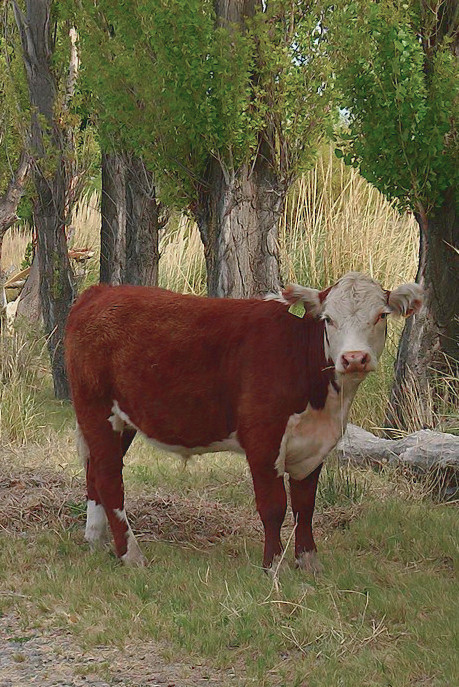
Hereford cattle. This breed is characterized by being red with white spots on the head and lower body.
 Cattle farming
At Estancia La Caledonia we were faced with an indisputable reality: the weather and market prices were making us rethink our production strategy. For years, we had opted for sheep farming, but the increasingly intense and prolonged droughts made it increasingly difficult to sustain this activity. Furthermore, wool prices were not competitive enough to justify the investment and effort.
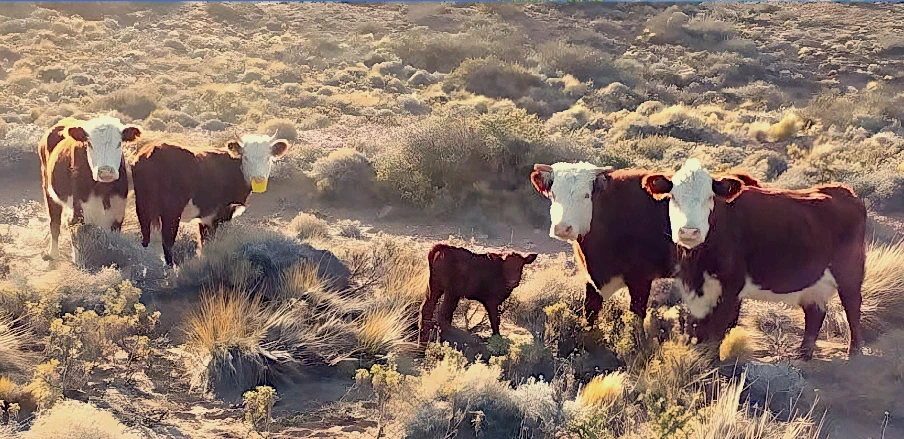
We started small... seven Herefords and one Angus.
The global demand for healthy meat motivated us to embark on this new adventure, even though we knew that it would require specialized handling and complex logistics. Over time, our experience in managing cow breeding allowed us to confirm that we were facing a production alternative with a great future ahead of it.
As of today, we have established a sustainable system that allows us to obtain high production quality and the most demanding health and animal welfare standards. We are proud to have made the decision to switch to cow farming and we are working to improve and establish ourselves as a leader in high quality production.
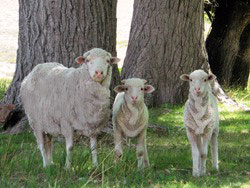
This sheep is daughter of one of the best rams in the field. Its the kind of breed of sheep that breeds twins.
 Merino Sheep
From the beginning, we bred merino race. During the wool crisis in this area, producers were forced to adapt to the hasrd times, dealing with production costs and improving the genetic quality of sheep by adopting new technologies. We haved a staff that carries out sheep artificial insemination using national champions.
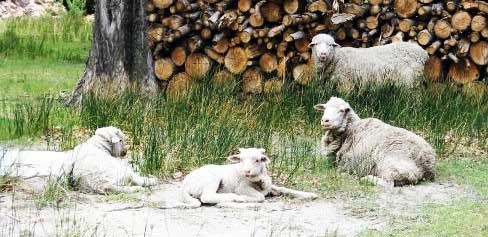
Sheep that are orphan, remain in the main paddock
We also obtained good results in breeding by using laparoscopy insemination, carried out with sheep from Australia, always with the advice of relevant bodies such as the Association of Breeders of Merino Argentina and INTA.
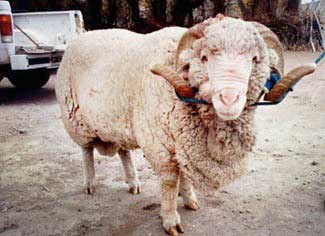
This ram costs u$s1500 due to its ultrathin wool.
We carried out the shearing and antepartum, with a strict classification and conditioning of wool. To prevent overgrazing and desertification we rotated the flock of sheep. By using these techniques, it resulted in a clean fiber of 17.5 to 19.5 microns. The quality that allowed us to export directly from the establishment.
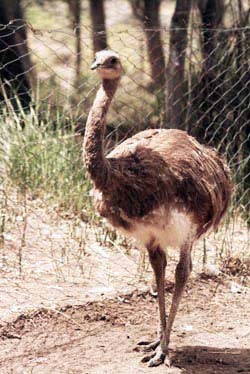
The Choique is certainly the bird that characterizes Patagonia.
 The Choique
Historically, it is known for its suppleness. Aboriginal people revered him, ate his flesh, wrapped with its leather, used its fat as medicine, and adorned with feathers. Today it is at the verge of extinction.
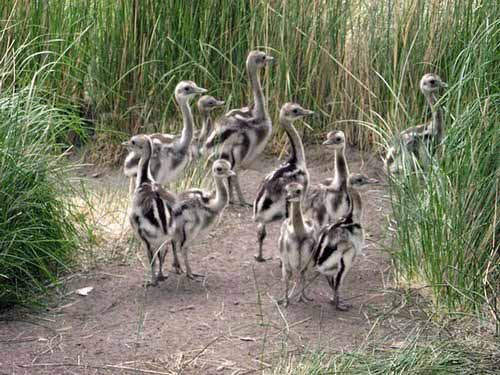
Charitos are the offsprings of Rhea. Curiously, its plumage is black and white at first. then it turns gray as they grow.
We began to breed them in captivity because its meat is very healthy and desired worldwide. Our experience in breeding allowed us to state that we certainly haved a prosperous future in exotic meat production.
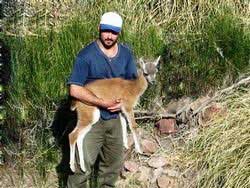
"Chulengo" is the offspring of Guanaco.
They are very docile and sociable.
 The Guanaco
This camelid (Lama guanicoe), is a native Patagonian resident that represents the ninety-five percent of the total population of Patagonia. It is docile, friendly and adapted to human contact. The Guanaco provides extremely soft wool.
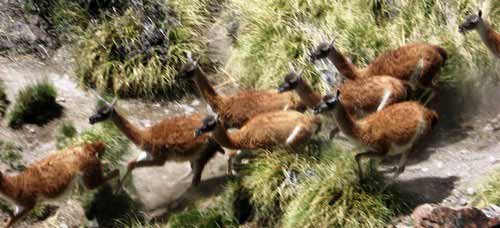
Guanaco, Lama Guanicoe
At the begining they come from a wild enviroment and then they are kept in semi-captivity. The Ministry of Natural Resources of the Province of Rio Negro control the number of these animals and gives permission to breed them.
For many years the wool was sold illegally at high prices because it was considered to be similar to the wool of the vicuna for its high quality. Today, the situation has changed, because now it can be sold legally at reasonable prices.
